Industry & Brand News
Window Robot Nozzle Clogs: Hard Water, Scale and Fixes
Window cleaning robot spray nozzles clog with limescale and dried cleaner. Learn the fix, the water rules, and what OEM buyers should specify.
Window Robot Nozzle Clogs: Hard Water, Scale and Fixes
The pump runs, the tank is full, and nothing comes out of the spray nozzles. Or worse: one side sprays, the other does not, and the robot drags a dry pad across half the window.
In service reports, a clogged nozzle is one of the most common window robot faults — and one of the most preventable. The orifices are tiny, the water is often hard, and the cleaning solution is often wrong.
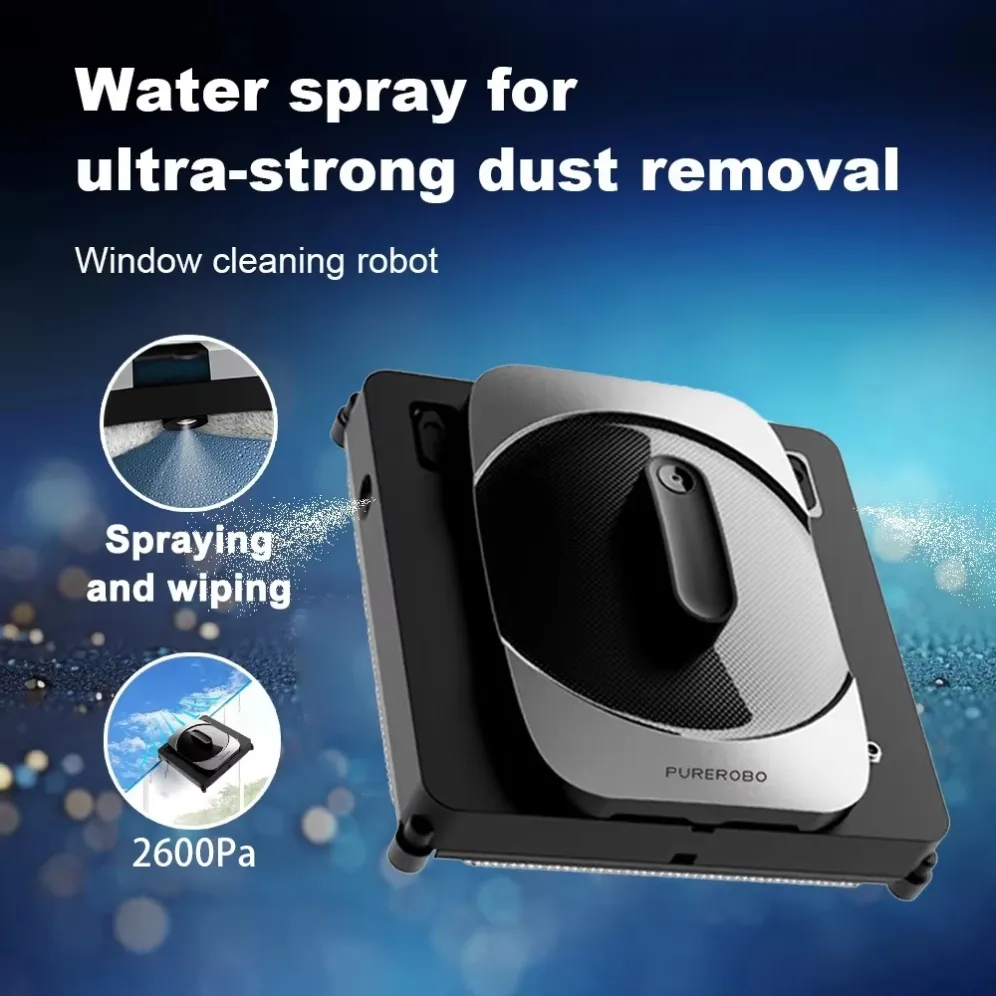
The fine mist that makes a window robot effective comes from openings smaller than a millimetre — which is exactly why they clog first.
Why nozzles clog
A spray nozzle has an opening well under a millimetre. That is what creates an even mist. It is also what makes it vulnerable.
Three things block it:
- Limescale. Hard water leaves calcium and magnesium deposits as it evaporates. Repeated cycles build a crust inside the orifice and the tube behind it. In hard-water areas this is the dominant cause.
- Dried cleaning solution. Thick, foaming or over-concentrated products leave a film that dries into a plug. Dish soap is a common culprit.
- Dust and debris. Fine grit enters the tank during filling and settles in the line.
A clean orifice (left) versus limescale crust narrowing the opening (right). Even a partial blockage changes the spray pattern.
The symptoms
A clog does not always announce itself as "no spray". Watch for:
- weak or absent spray on one or both sides
- a deflected spray pattern (wet patch in one corner, dry elsewhere)
- uneven coverage that leaves streaks even with a clean pad
- the pump running with no liquid movement
- a spray that starts strong and fades within seconds
If the pump is audible but the pad stays dry, the nozzle or line is the first suspect — not the pump.
Two patterns narrow it further. A spray that returns after a refill and fails again within a day usually points to a cap seal or an air leak, not scale. A spray that is strong on one side and absent on the other points to a single nozzle, not the pump.
One side misted, one side dry: the classic signature of a single blocked nozzle rather than a failing pump.
The fix in five steps
- Check the tank and cap. The simplest cause is a cap not fully closed or a tank not seated. Confirm liquid reaches the outlet.
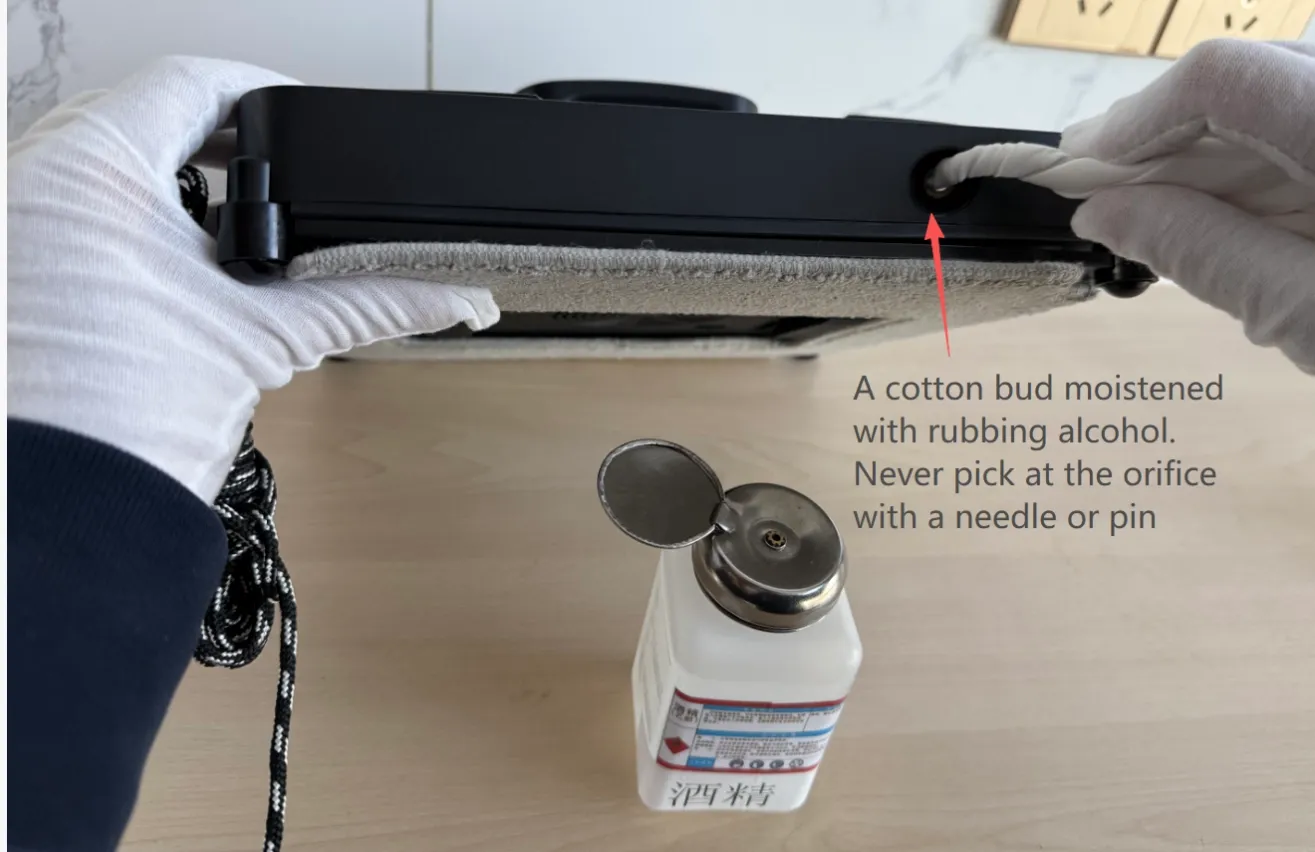
- Clean the nozzle gently. Use a cotton bud moistened with rubbing alcohol. Avoid needles and pins; they can deform the orifice permanently. If the manual permits a fine tool, insert no more than about 1 mm, without force.
- Trigger the spray manually several times to flush the line. A few short pulses move more debris than one long spray.
- Descale for moderate buildup. Empty the tank, mix a gentle white-vinegar solution (about 1 part vinegar to 2–3 parts warm water), run it to the nozzle, let it sit for 10–15 minutes, pulse the spray, then rinse thoroughly with clean water over several cycles.
- Finish with demineralised water. A final flush with distilled or demineralised water clears the vinegar residue and the loosened minerals.
If the spray returns but is weak, repeat the descale once. If nothing changes after two attempts, the line or pump may need service.
Step two in practice: a cotton bud moistened with rubbing alcohol. Never pick at the orifice with a needle or pin.
The water question is not one-size-fits-all
The standard advice is "use distilled water". It is good advice for most robots, because distilled water carries no minerals and cannot scale the nozzle.
But there is an important exception. Some window robots measure water level with electrode sensing, which relies on the water conducting a small current. Pure distilled water may not be detected, so those manufacturers explicitly recommend their own solution or tap water instead.
Before switching, check the manual. The safe rule is:
- If the manual allows distilled water: use it, especially above 200 ppm hardness.
- If the manual requires a proprietary solution or tap water: follow it, and descale on schedule.
- If the robot uses capacitive sensing: distilled water is usually fine, but confirm with the factory.
A robot designed for distilled water is easier to support in hard-water markets. That is a specification decision, not an accessory.
What not to use
- Tap water in hard-water areas — the fastest route to scale.
- Dish soap and household detergents — they foam, leave film, and can damage seals.
- Thick or silicone-based cleaners — they crystallise in the nozzle.
- High-concentration solutions — more is not better; follow the dilution.
- Bleach or aggressive acids — they attack seals and sensors.
- Warm water alone — fine for a light rinse, but it will not dissolve scale.
A maintenance schedule that prevents clogs
Frequency | Solutions |
After each use | Empty the tank; wipe the nozzle; park the robot off the glass |
Weekly | Inspect the spray pattern; pulse-flush the line |
Monthly (hard water) | Descale with a gentle vinegar solution; rinse with distilled water |
Seasonal | Replace pads; inspect seals and the tank filter |
Storage | Empty and dry the tank; do not store solution in it |
The "park off the glass" step matters: a pad left pressed against glass can leave an imprint and keep the nozzle area damp.
Why the right water depends on the sensor
"Use distilled water" is common advice, but it is not universal. The correct answer depends on how the robot measures water level.
Sensing method | How it works | Distilled water |
Electrode | Measures conductivity between probes | May not register; some brands forbid it |
Capacitive | Measures the electrical field | Works normally |
Float switch | Mechanical float | Works with any water |
Optical | Detects the water surface | Usually works |
This is why some manufacturers insist on their own solution or tap water: the sensor needs ions to detect the level. A distributor who sells into a hard-water region needs a model whose sensing method is compatible with distilled water — otherwise the user is trapped between scale and a sensor that cannot see the water.
Electrode probes need conductive water to register a level; capacitive plates read the electric field and work with distilled water.
Ask the factory one question: what sensing method is used, and is distilled water supported? The answer decides the maintenance burden for the life of the product.
A descale procedure that does not damage the unit
Descaling is mild chemistry, not a repair. Keep it gentle:
- Empty the tank and the line.
- Mix about 1 part white vinegar to 2–3 parts warm water — not strong acid, not bleach.
- Run the solution to the nozzle and let it sit for 10–15 minutes. Do not leave it overnight.
- Pulse the spray several times to move dissolved deposits.
- Flush with clean water through two or three tank fills.
- Finish with demineralised water.
- Check for leaks at the tank and nozzle after reassembly. If a seal leaks, stop and service it.
Do not descale a hot unit, and do not mix vinegar with other cleaners. Repeat once if the spray is still uneven; if two descales do not restore flow, the line or pump needs service.
Support script: three questions before replacement
Most "no spray" cases can be triaged in three questions:
- Does the pump run? If yes, the fault is likely the nozzle or line. If no, check power, tank seating and the pump.
- Is it one side or both? One side points to a single nozzle; both point to the tank, cap, filter or main line.
- When did it last spray normally? After a refill suggests an air lock; a gradual decline suggests scale.
Then: clean the nozzle, descale, retest. Replace the unit only after two failed descales or a confirmed pump fault.
What OEM/ODM buyers should specify
# | Specification | What to ask for |
1 | Nozzle access | Removable or cleanable without tools |
2 | Orifice size | Diameter and spray pattern |
3 | Filtration | Tank filter or inline strainer |
4 | Water-level sensing | Electrode vs capacitive; distilled-water compatibility |
5 | Descale mode | Manual procedure or app-guided cycle |
6 | Materials | Seal and tank compatibility with mild acid descaling |
7 | Tank | Wide opening; drainable; no blind corners |
8 | Solution | Recommended type and dilution ratio |
9 | Manual | Water type, descale interval, nozzle cleaning |
10 | Test | Hard-water spray test (see below) |
A nozzle test plan
A spray system can be tested before launch with a simple protocol:
- Water: 300 ppm hardness (or the local worst case).
- Cycles: 100 spray cycles with the recommended solution.
- Measure: flow rate per nozzle, spray pattern coverage, and time to first blockage.
- Descale: run the recommended descale procedure and measure recovery.
- Pass: flow within ±10% across nozzles after descale; no permanent blockage.
A product that survives 100 hard-water cycles with a documented descale is a product that will not generate "no spray" reviews in year one.
How Purerobo approaches spray systems
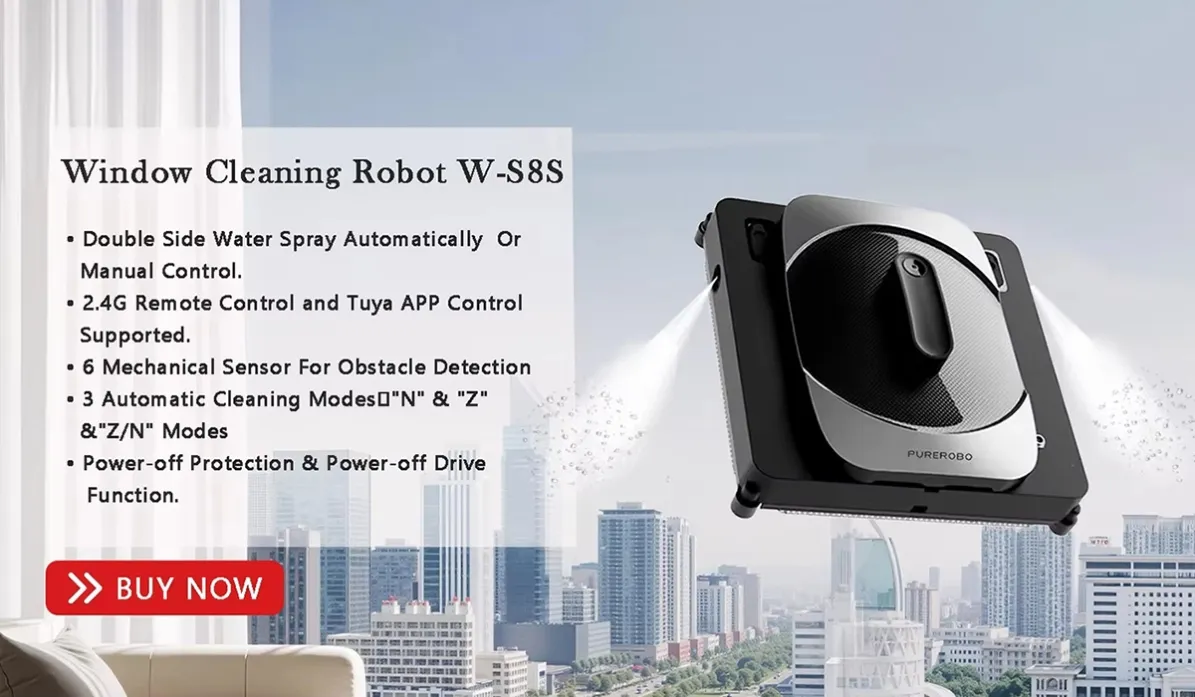
The W-S8S uses dual-sided water spray with ultra-fine microfibre pads, and supports glass from 3 mm and above. The round W-R4S platform runs a 4,000 Pa fan with 2,400–2,600 Pa whole-machine suction.
For OEM/ODM projects, we confirm the water type and sensing method before quoting, because the wrong combination creates a support problem that no manual can fix.
FAQ
Why is my window cleaning robot not spraying? Usually a clogged nozzle or line from limescale or dried solution. Check the tank and cap, clean the nozzle, then descale.
Can I use tap water? It works, but hard water scales the nozzle. Use distilled water if the manual allows it; otherwise descale on schedule.
Why does the manual forbid distilled water? Some models use electrode water-level sensing, which may not detect pure water. Follow the manual for that model.
How often should I descale? Monthly in hard-water areas, or every 25–50 tanks. Descale sooner if the spray pattern becomes uneven.
Can I use dish soap? No. It foams, leaves film, and can damage seals and nozzles.
Sourcing a window robot for hard-water markets?
Send us your target market, water hardness and cleaning-solution preference. We will confirm the nozzle, sensing method and descale procedure, and quote a sample.